|
The theory of radiative forcing—central to modern climate
orthodoxy—rests on assumptions that defy thermodynamic logic and
observational reality. By examining Venus’s extreme surface temperatures
and comparing them with Earth’s energy budget, this article challenges
the notion that greenhouse gases like CO₂ and methane drive planetary
warming. Instead, it argues that gravitational gradients, cloud
dynamics, and natural variability offer a more coherent explanation. The
implications are profound: if radiative forcing fails, then so too does
the rationale behind Net Zero policies and the trillion-dollar climate
agenda.
The prevailing climate narrative collapses under scrutiny. To
illustrate, imagine a lake perched atop a mountain, with a stream
flowing down its slope. Now suppose someone builds a small dam at the
base of that stream, its wall far lower than the lake’s elevation. Would
anyone seriously claim that this dam could raise the level of the lake
above? Yet this is precisely the kind of backward logic embedded in the
theory of radiative forcing.
How planetary thermodynamics expose the myth of trapped heat
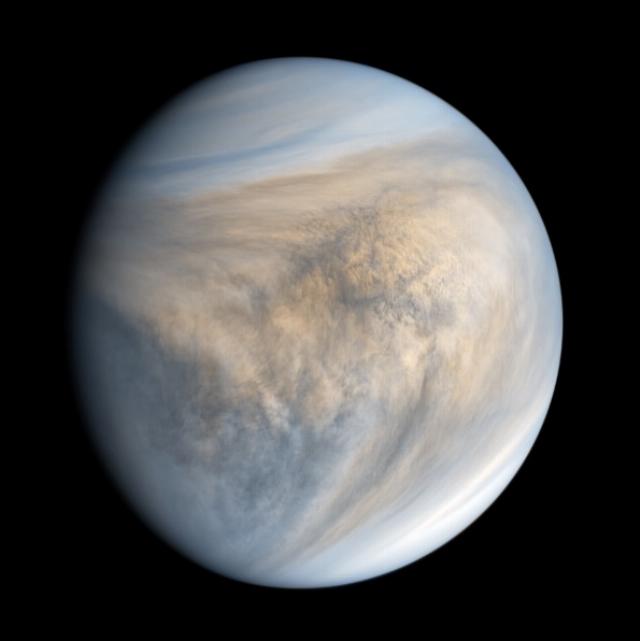
Climatologists have failed to explain how Venus’s surface became so
extraordinarily hot in the first place. Even if we accept that the
surface is somehow heated, there must be a mechanism for slight
warming—perhaps 1 to 5 degrees—on the sunlit side to compensate for
inevitable cooling during the long Venusian night.
But downward winds cannot warm the surface, and in any case, Venus’s
circulation is not simply downward on the day side and upward on the
night side. The dynamics are far more complex and do not support the
notion of sustained surface heating from above.
Even more critically, once energy is released from the
surface—whether by radiation or convection—it cannot all be returned to
the surface to maintain its temperature. That would require all the
energy that was emitted by radiation in the first place, as well as that
which cooled the surface by convection—violating basic thermodynamic
principles because the convected energy cannot add to the radiation from
CO₂.
Some of that energy, especially via convection, must escape to Space.
Also, in accord with thermodynamic laws, that which is radiated from
less-hot regions in the atmosphere cannot create heat that increases the
temperature of the already-hotter surface.
Why CO₂ and methane don’t drive surface temperatures—on Venus or Earth
Carbon dioxide cannot “trap” convective heat any more than other
gases on Venus and, similarly, nitrogen, oxygen or argon on Earth. It’s a
physical impossibility.
So let us now consider Earth. CO₂, CH₄, and H₂O cannot retain thermal
energy that they have absorbed solely from radiation, and yet then send
more energy back to the surface than was originally released by the
surface, that original surface cooling being not only through radiation,
but also by conduction, convection, and evaporation.
There is no significant difference between Earth and Venus in this
regard. Both planets receive far too little direct solar radiation at
the surface to explain their observed temperatures using the
Stefan-Boltzmann Law.
For instance, Earth’s surface receives approximately 161 W/m² of
solar radiation—insufficient to account for a global mean temperature
above about 230 K (−43°C). There is no valid mechanism whereby a system
can send back to the surface more energy than the surface had lost while
cooling. This discrepancy exposes the fundamental error in radiative
forcing theory.
The flawed logic behind Net Zero and the billion-dollar climate agenda
Radiative forcing assumes that, if there is a small imbalance between
incoming and outgoing radiation at the top of the atmosphere, then that
difference drives surface temperature changes. But this interchanges
cause-and-effect.
In reality, it is natural variations in surface temperature—driven by
factors such as cloud cover, cloud altitude, and latitude—that cause
fluctuations in radiative balance. Cloud cover, for example, has less
effect in polar regions than in tropical ones, and shifts in global
cloud distribution can easily account for observed temperature changes.
The magnitude of the temperature gradient in the troposphere (which is formed by gravity
at the molecular level) also has a significant effect. This so-called
“lapse rate” varies with the concentration and distribution of water
vapor, as is well known.
So, Venus, far from validating greenhouse theory, actually helps
dismantle it. The planet’s thermal behavior underscores the
implausibility of radiative forcing as a mechanism for surface warming.
Carbon dioxide and any other so-called “greenhouse” gases have no
meaningful bearing on planetary temperatures and pose no threat. It
follows that the entire “Net Zero” agenda is built on a false
foundation—one that is costing nations billions in pursuit of a phantom
crisis.
Douglas J. Cotton, American Thinker:
https://www.americanthinker.com/articles/2025/10/venus_and_t...
|
















No comments:
Post a Comment